


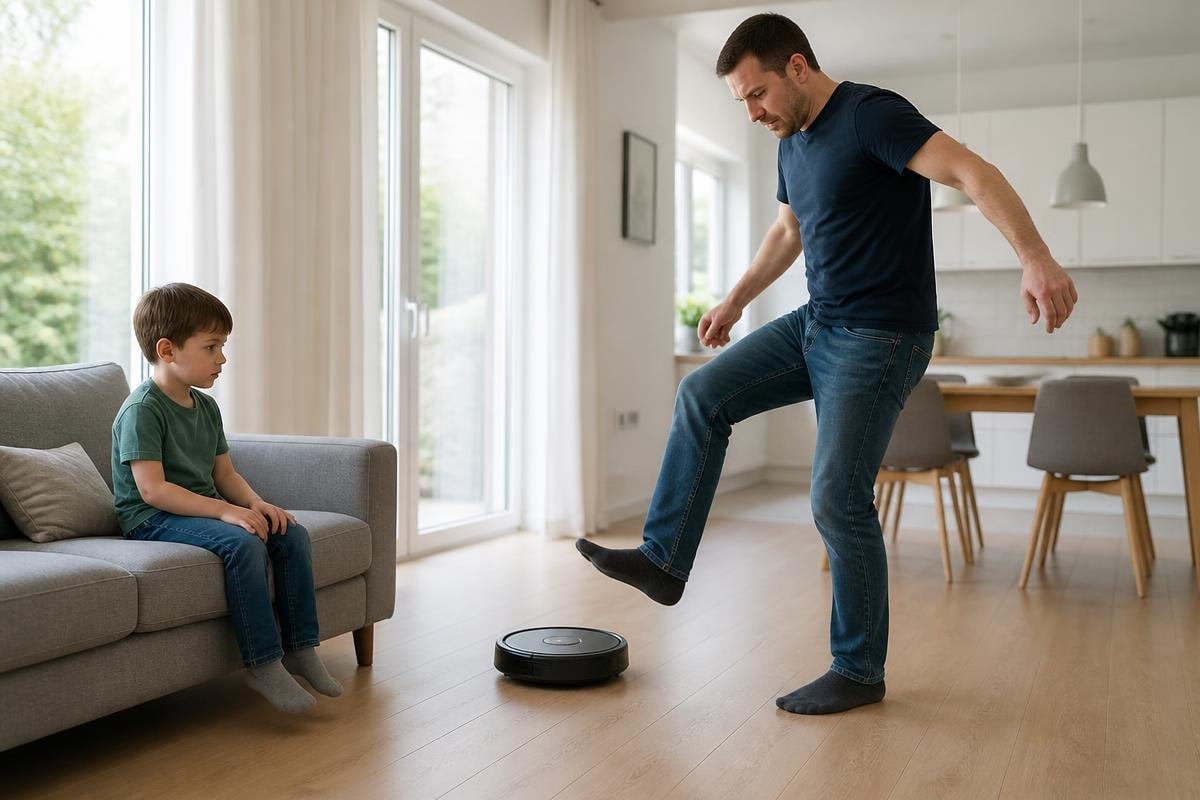
A child watches an adult kick a robot vacuum, praise a robot arm, or speak to a voice assistant. The machine may be simple, but the lesson is not: people learn how to treat tools by watching what happens around them.
- Robots are machines, not people with feelings
- Safe handling matters more than dramatic commands
- Adult behavior shapes trust in automation
Children read the behavior first
Children may not understand motors, sensors, or software yet. They can still see when an adult handles a machine with care, treats it as disposable, or blames it for a task it was never built to do.
That difference matters because robots act in physical spaces. A robot vacuum moves across a floor. A robot arm closes a gripper around an object. A mobile robot may stop when a person enters its path. Each action gives a child something concrete to watch.
Adults also teach through tone. Speaking to a robot as if it has feelings can make a child treat the machine like a person. This is called anthropomorphism, which means giving human traits to something that is not human. The habit can make play richer, but it can also blur the difference between a machine and a living thing.
A clear explanation keeps the line in place: “The robot stopped because its sensor saw your hand,” rather than “The robot got upset.” The first sentence teaches a cause. The second assigns a feeling that the machine does not have.
Care shows what a machine is worth
Children notice how adults handle objects that cost money or help with work. An adult who keeps a robot’s charging area clear, checks its cable, and follows its safety steps shows that care protects useful equipment.
The same lesson works in the other direction. If an adult hits a robot when it fails, a child may copy the action without understanding the fault. The robot may have lost a map, met an object outside its settings, or reached a low battery. Physical punishment cannot fix any of those problems.
I think adults should treat failed robot behavior as a fault to inspect, not a reason to punish the machine. That response gives children a better habit: pause, look at the system, and ask what caused the result.
Commands teach limits and responsibility
A robot follows its software, sensors, and physical design. It may not lift a heavy object, cross a step, or understand a vague instruction. When adults ask for tasks beyond those limits, children see a poor command followed by a poor result.
A better pattern uses clear requests and checks the setting first. An adult can point out the robot’s working area, show where a person should stand, and explain why an emergency stop exists. The child learns that automation needs boundaries set by people.
This lesson reaches beyond toys. Watching an adult check a robot arm before reaching near it teaches that speed never replaces safe distance.
Seeing an adult review a robot’s camera view teaches that machines can collect information and still need limits.
That lesson gets stronger when adults use reporting on real robots to show what a machine did and where a person had to step in. A child can learn to ask for proof before trusting a robot.
Trust needs proof, not praise
Adults shape a child’s trust in automation by how they describe success. Calling a robot “smart” after one good task hides the work done by sensors, code, and set limits. Showing the exact result gives the child a better measure.
That result might be a robot arm placing one object in a marked area, or a mobile robot stopping before a person. The child can then ask what happened when the object moved, the floor changed, or the sensor was blocked.
This approach leaves room for doubt. A robot can work well in one room and fail in another. It can repeat a task many times, then stop when its battery drops or its route is blocked. Children learn that trust grows from observed results, not from confident language.
A useful adult checklist
Use this guide when a child watches or operates a robot:
- Name the part: explain the motor, sensor, camera, gripper, or battery involved.
- State the limit: say what the robot cannot lift, see, reach, or understand.
- Keep distance: mark where hands and feet must stay during movement.
- Check the cause: inspect power, cables, sensors, and the robot’s task settings after a failure.
- Set a privacy rule: explain what the robot records and who can view it.
- Invite a question: ask what the child noticed before giving the answer.
The adult’s response becomes part of the child’s working model of automation. Care teaches responsibility, clear limits teach judgment, and honest explanations leave children ready to question what a robot can actually do. The next robot they meet will be judged by its actions, not by its voice or face.
